
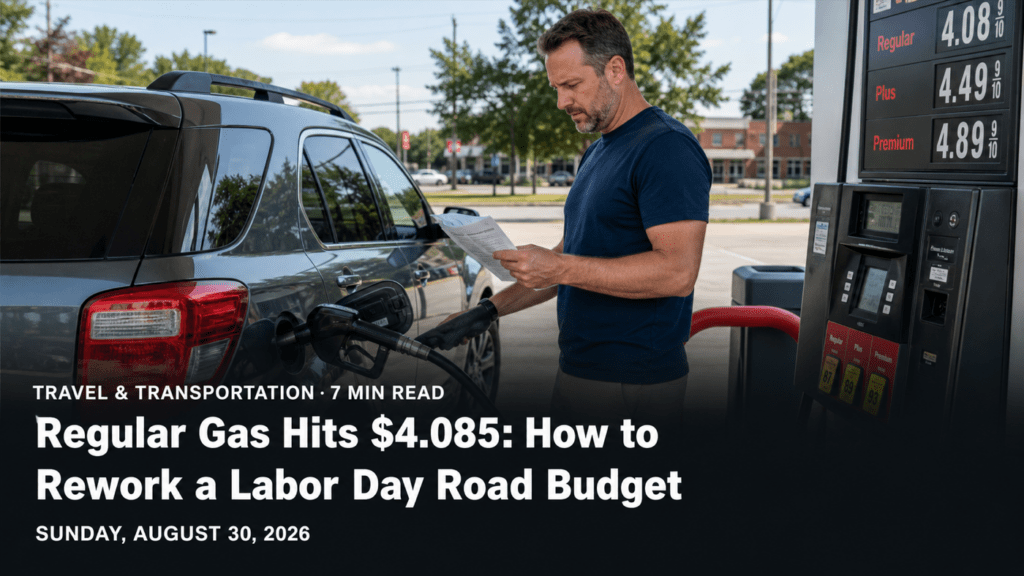
The national average price for regular gasoline reached $4.085 a gallon on August 24, raising the cost of a late-summer road trip and widening regional differences.
The Bottom Line
U.S. regular gasoline averaged $4.085 a gallon in the Energy Information Administration’s August 24 weekly data, up 3.6 cents from August 17 and 93.8 cents above the comparable week a year earlier. A 600-mile trip in a vehicle getting 25 mpg would use about 24 gallons and cost roughly $98 at the national average—about $23 more than at the year-earlier national price.
What the latest data show
EIA’s weekly series measures average retail prices including taxes. The national figure is useful for comparison, but drivers encounter local prices that can differ substantially because of taxes, fuel specifications, distribution costs and supply conditions. On August 24, the Lower Atlantic and Gulf Coast were below the national average, while the Rocky Mountain and West Coast regions were higher.
The national average had been $4.006 on August 10, rose to $4.049 on August 17 and reached $4.085 on August 24. That sequence shows a late-August increase, but three weeks do not establish a lasting trend. Crude-oil markets, refinery operations, storms, seasonal fuel transitions and regional inventories can all move prices.
| Trip distance | Fuel at 25 mpg | Cost at $4.085 |
|---|---|---|
| 300 miles | 12 gallons | About $49 |
| 600 miles | 24 gallons | About $98 |
| 1,000 miles | 40 gallons | About $163 |
How to build a realistic road budget
Start with miles, not tanks. Divide the round-trip distance by your vehicle’s realistic highway fuel economy, then multiply by the price you expect along the route. Add local driving at the destination and a 10% mileage cushion for detours, congestion and errands. If the vehicle is loaded, towing or using a roof box, assume lower fuel economy than the sticker estimate.
Fuel is only one variable. Tolls, parking, meals and a night of lodging can outweigh the gas difference. A household deciding between driving and flying should compare the full door-to-door cost for all travelers, including airport transportation, baggage, rental-car charges and schedule flexibility.
Three ways to limit the surprise
- Price the route before departure. Check several stops, but do not drive far out of the way to save a few cents.
- Use realistic efficiency. Base the budget on recent trip mileage, especially when carrying passengers or luggage.
- Separate savings from safety. Maintain tires at the manufacturer’s recommended pressure and avoid risky driving practices simply to reduce fuel use.
Quick calculator
Trip fuel cost = total miles ÷ expected mpg × price per gallon. For 600 miles at 25 mpg and $4.085 a gallon: 600 ÷ 25 × 4.085 = $98.04. Add a 10% mileage cushion and the planning amount becomes about $108.
What to Watch
- EIA’s next weekly gasoline-price release.
- Regional prices along the actual route, not only the national average.
- Weather or refinery disruptions that can create short-term jumps.
- Tolls, parking and lodging changes that may matter more than fuel.
Regional averages change the answer
A traveler crossing several regions should not multiply the entire trip by the national average and assume precision. The national number is a planning reference. Actual stations can be materially higher or lower, and interstate locations may charge more than nearby towns. A more useful estimate divides a long route into segments and applies a reasonable price to each.
That does not mean a driver should chase the lowest posted price. A ten-mile detour to save ten cents per gallon on a 12-gallon purchase saves only $1.20 before accounting for the extra fuel and time. Convenience, personal safety and vehicle range should remain part of the decision.
Efficiency assumptions can move the budget
A vehicle rated at 30 mpg may deliver less when heavily loaded, driven at high speed, idled in traffic or equipped with a roof carrier. A large SUV or pickup may also use considerably more fuel than the 25-mpg example. Use recent dashboard or fill-up data from similar driving rather than the best-ever number.
Maintenance affects both safety and fuel use. Check tire pressure when tires are cold and use the pressure listed by the vehicle manufacturer, not the maximum printed on the tire sidewall. Address warning lights and overdue service before a long trip. Smooth acceleration and steady speeds can help efficiency, but drivers should never compromise safe merging, visibility or traffic flow.
Build a complete travel comparison
For a household of four, driving can still compare favorably with four airline tickets, especially when the destination requires a rental car. For one traveler, flying may be competitive once lodging for an overnight drive, parking and vehicle wear are included. The right comparison is the incremental cost of each option, not fuel alone.
Set aside a separate contingency amount for a tire repair, unexpected toll, weather delay or additional night. Avoid committing every dollar to the planned itinerary. A clear fuel calculation is useful because it exposes one part of the budget, but the reserve is what keeps an ordinary disruption from becoming high-cost credit-card debt.
A simple planning sequence
Map the round trip, add local miles, estimate fuel from realistic mpg, price major tolls and parking, and compare lodging and meals. Then add 10% to the driving miles and a separate emergency reserve. Recheck the route and vehicle the day before departure. This approach turns a volatile national price into a household number that can be adjusted without guessing.
Sources and Methodology
This analysis uses the U.S. Energy Information Administration’s weekly U.S. regular gasoline price series through August 24, 2026. Trip estimates are rounded illustrations; actual mileage and local prices vary.
Read Also
Browse the latest American Media Press reports
This article provides general educational information and does not guarantee travel costs or fuel prices.


