The Bottom Line
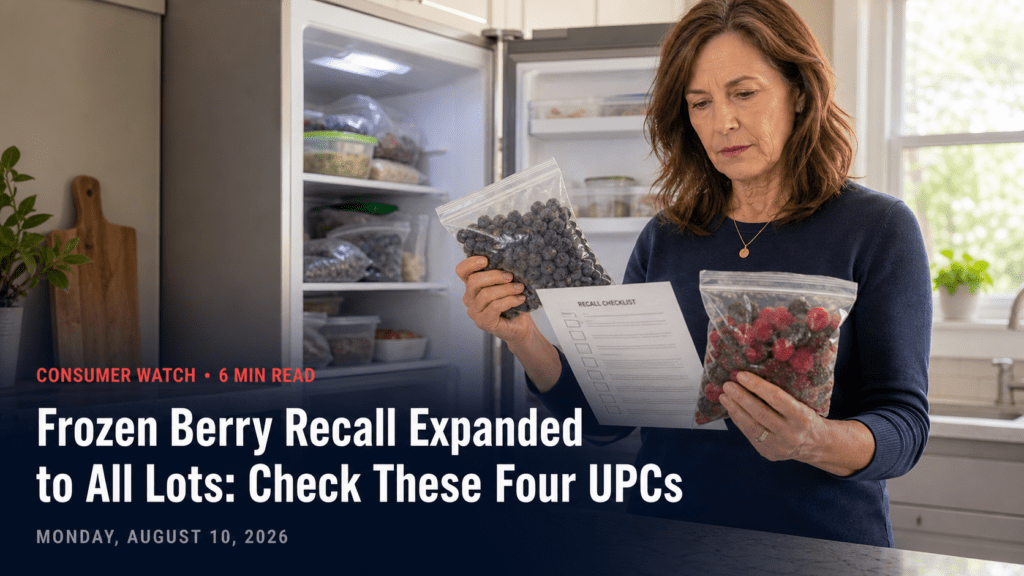
Do not eat any GreenWise Organic Whole Blueberries or Whole Mixed Berries covered by this recall. The expanded action includes all lots of four products in 10-ounce and 48-ounce packages. Throw them away or return them to Publix for a full refund, then wash containers and surfaces that may have touched the berries. The FDA reports 12 illnesses, four hospitalizations and no deaths as of its July 30 update.
Why the recall became broader
The first public recall, announced July 3, covered one 10-ounce lot of GreenWise Organic IQF Blueberries: lot code 60401, shown on the package as 6 040 01, with a best-by date of February 9, 2028. The later Publix action is substantially broader. On July 29, the retailer recalled all lots of GreenWise Organic Whole Blueberries and Whole Mixed Berries in two package sizes.
According to the FDA, its investigation and a remote regulatory assessment of the Chilean supplier raised concerns about at least one additional lot used in other frozen GreenWise products. That is why consumers should no longer rely on the original lot code alone. If the product name, size and UPC match the expanded list, it is recalled regardless of the printed lot.
The complete household checklist
| Product | Size | UPC | Lots |
|---|---|---|---|
| GreenWise Organic Whole Blueberries | 10 oz | 41415-06453 | All lots |
| GreenWise Organic Whole Blueberries | 48 oz | 41415-12053 | All lots |
| GreenWise Organic Whole Mixed Berries | 10 oz | 41415-06753 | All lots |
| GreenWise Organic Whole Mixed Berries | 48 oz | 41415-12153 | All lots |
The products were shipped to Publix stores in Alabama, Florida, Georgia, Kentucky, North Carolina, South Carolina, Tennessee and Virginia. FDA cautions that distribution can sometimes extend beyond confirmed states, so a matching product should be treated as recalled even if it reached the household through travel, delivery, resale or another route.
What the outbreak numbers show
Cases have been reported in Florida and Georgia, with illness onset dates ranging from May 11 through June 5. Seven of nine people interviewed reported eating frozen blueberries, and five specifically identified GreenWise organic frozen blueberries purchased from Publix. These figures support the investigation, but they do not prove that every recalled package is contaminated or that every illness has been identified.
The confirmed facts are the recall scope, the case counts reported by FDA and the public-health recommendation not to consume the listed products. The source of contamination remains under investigation, and FDA says additional products could be added if new evidence emerges.
What to do in your kitchen
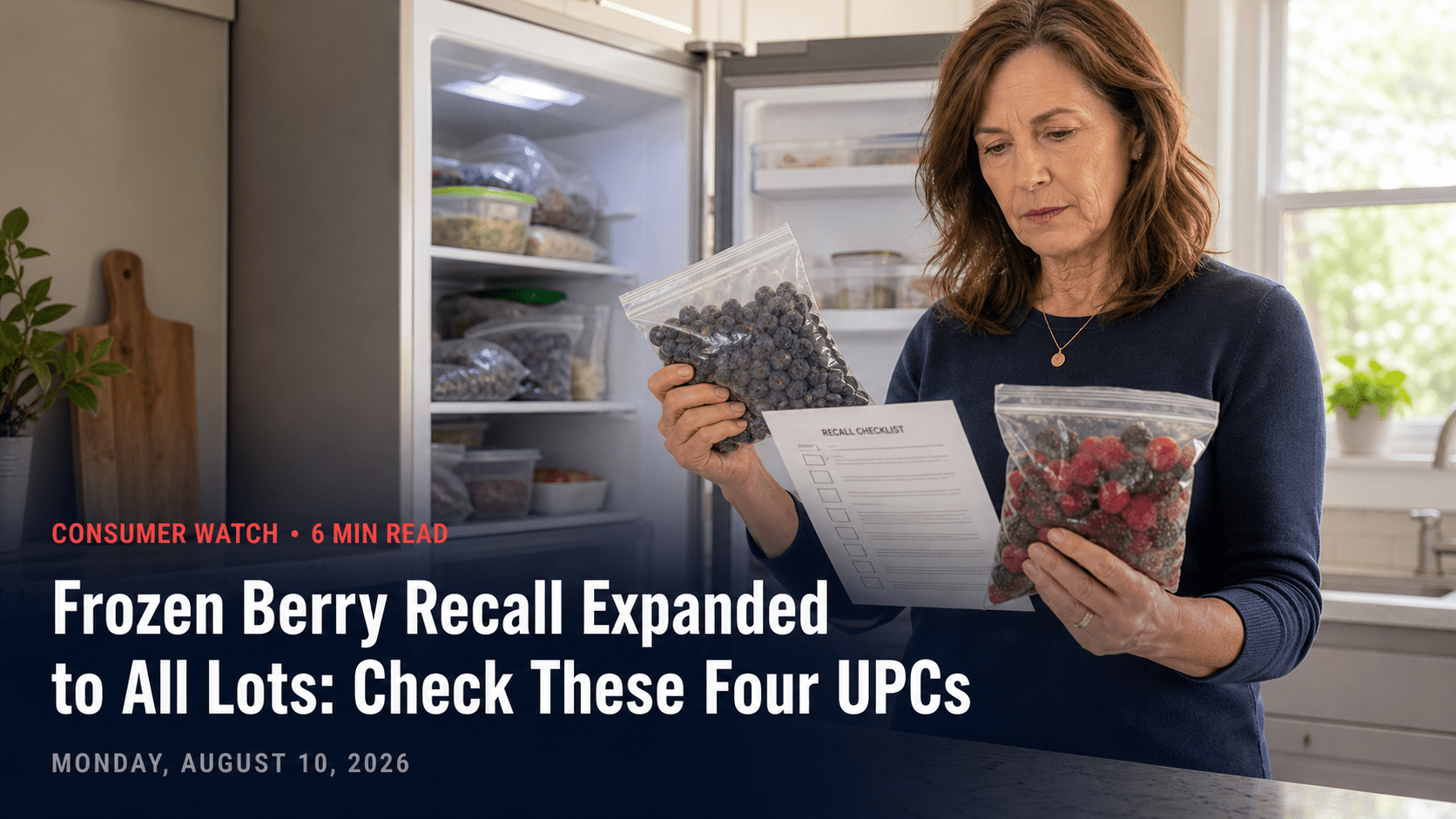
- Check every frozen berry package. Match the product name, size and UPC. Because all lots are included, a different lot or best-by date does not remove a matching product from the recall.
- When the packaging is missing, use the cautious rule. FDA advises discarding frozen berries stored without their original package if you cannot determine whether they are recalled.
- Do not taste the product to test it. Return the package to Publix for a full refund or place it in a sealed bag before disposal so another person or animal does not consume it.
- Clean contact points. Wash reusable containers, freezer drawers, counters, utensils and blender parts that touched the berries with hot soapy water or in a dishwasher where appropriate.
- Check shared food. Smoothie packs, homemade frozen portions or desserts may contain berries removed from the original bag. If the source cannot be verified, discard them.
Symptoms and when to seek care
Shiga toxin-producing E. coli can cause severe stomach cramps, diarrhea that may be bloody, nausea, fever and vomiting. CDC says symptoms usually begin three to four days after exposure and most people recover within five to seven days, while FDA notes that onset can occur up to nine days after eating contaminated food.
Contact a healthcare provider for bloody diarrhea, diarrhea lasting more than three days without improvement, fever above 102°F, vomiting that prevents liquids from staying down, or signs of dehydration such as very little urination, dry mouth or dizziness when standing. Some infections can lead to hemolytic uremic syndrome, a serious kidney complication that may require hospitalization. Older adults, young children and people with weakened immune systems face greater risk of severe illness.
Practical refund note
Publix says customers may discard the recalled products or return them for a full refund. Keep a photo of the package, UPC and any receipt before disposal if you expect to request reimbursement. Questions can be directed to Publix Customer Care at 800-242-1227, Monday through Friday, 8:30 a.m.–5:00 p.m. Eastern.
What to Watch
- Whether FDA adds products, lot information or distribution locations to the advisory.
- Any change in the 12-illness, four-hospitalization case count.
- Results from FDA’s ongoing work to identify the contamination source and evaluate the supplier’s corrective actions.
- Further consumer instructions from Publix, FDA or CDC.
Sources and Methodology
This report uses the FDA outbreak investigation updated July 30, the FDA-posted Publix recall announcement and CDC’s outbreak advisory. Product names, sizes, UPCs, distribution states, case counts and health guidance were checked against those official pages on August 10, 2026.
- FDA outbreak investigation
- FDA-posted Publix recall announcement
- CDC outbreak advisory
Read Also
Latest News | Podcasts
Health information notice: This article provides general information and is not individualized medical advice. Seek professional care for concerning symptoms or emergencies.