
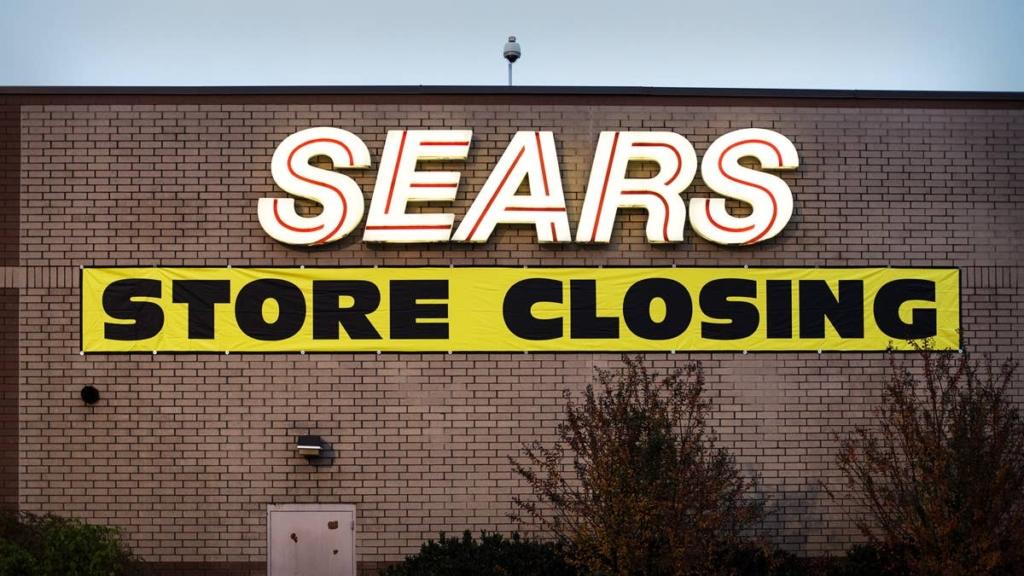
Imagine a world where Walmart only has five stores left.
It’s unthinkable because the company has dominated retail for so long, and it survived the pivot from pure brick-and-mortar operations to an omnichannel retailer.
Even if it sells explosive diarrhea lettuce, replaces its greeters with unsupervised raccoons, or puts the people behind Fyre Festival in charge of grocery pickup, the chain would suffer, but survive.
Sears, arguably the chain that served as the Walmart of its day, did not make any single mistake quite as epic as any of the silly ones listed above. Instead, the chain, which was bigger than Walmart by sales until 1990, according to Business Insider, made thousands of little mistakes.
The once-dominant retailer, founded in 1886, even survived the pivot from its catalog business to a store-based model.
Since 1990, however, the chain has slowly dwindled, selling off assets such as its Craftsman, DieHard, and Lands End brands and using the proceeds for ill-fated ideas that did not reverse the slide.
Now, while Sears has not shut down, the chain has five locations left and appears to have abandoned any realistic hopes of a comeback.
Sears Chapter 11 was the beginning of the end
Sears actually filed for Chapter 11 bankruptcy in 2018, according to court documents filed on PacerMonitor.
At the time, Global Data Managing Director Neil Saunders released a strong statement on the company.
“Today is a day that will live in retail infamy. That a storied retailer, once at the pinnacle of the industry, should collapse in such a shabby state of disarray is both terrible and scandalous in equal measure. However, it is not surprising because this is a destination that Sears has been headed towards for many years, with virtually no serious attempt having ever been made to change the trajectory,” he wrote.
Saunders called on the company to make big changes and made it clear that its current strategies were not working.
“Over the longer term it is still unclear what Sears hopes to accomplish. We believe there is no clear path to success. The group has tried to shrink its way to profitability for years to no avail, so it is hard to see why pursuing the same strategy under the auspice of Chapter 11 would result in a different outcome,” he added.
More Retail:
- Coca-Cola quietly hints at reinventing previously failed flavor
- Bath & Body Works quietly gains a competitive advantage
- Dollar General brings back old prices
He also foretold what would happen down the road with many of the company’s owned-and-operated brands, which had not yet been sold.
“Further asset sales may reduce debt, but they would not put the company on a sound financial footing nor would they solve the operating losses the group is racking up,” he shared.
Many analysts trace the true beginning of the chain’s downfall not to its Chapter 11 filing, but to its post-bankruptcy purchase by hedge fund operator Eddie Lampert in 2004.
Lampert merged the company with KMart in 2005, which Saunders also saw as a problem.
“The solution to Sears’ problems was to buy another retailer not doing well, and that was Kmart. Then they got a bigger bad business,” Saunders told CNBC. “Sears wasn’t investing or changing, and they started to suffer because of that.”
And while other retailers were investing, Sears was cutting back.
A report from Susquehanna Financial Group had said Sears in 2017 was spending roughly 91 cents per square foot to make upgrades both online and in stores, while J.C. Penney spent $4.13, Kohl’s was paying $8.12, and Best Buy was forking out $15.36 per square foot to make enhancements, CNBC reported.
“I think if it was any other retailer they probably would’ve already filed for bankruptcy,” Retail Metrics founder Ken Perkins told CNBC in 2018. “But in Sears’ case, someone with deep pockets is able to influx cash, extract real estate and sell off assets … the cupboard is running very bare and there isn’t a lot left.”
At its peak, Sears operated more than 2,700 locations.
Sears was sold off for parts
Sears did raise cash selling off its well-known brands.
Craftsman went to Stanley Black & Decker, which now sells it at Home Depot and other chains. DieHard was sold to Advance Auto Parts, and Lands’ End was spun off and still runs independently.
Some analysts have argued that Lampert’s only goal was to sell off Sears’ massive real estate holdings. Lampert also used those holdings to protect his investment in the company should it fail.
“If they go bankrupt, he remains in control of the company because, though he loses his equity stake, he’s their principal creditor,” former Sears Canada CEO and Columbia Business School Professor Mark Cohen told CNBC.
But Lampert has cordoned “off an enormous amount of assets through the loans he’s made, which have essentially protected him from what is eventually (going to) occur,” added Cohen.
Sears’ owner sold off hundreds of the chain’s properties to Seritage Growth Properties, a company he controls.
The problem is that “then you end up signing leases” and saddling the company with lease liabilities, Neil Stern, senior partner at retail consulting firm McMillanDoolittle, told CNBC.
Shutterstock
Lampert was sued over Sears’ sales
Sears creditors sued Lampert and other investors, a case which was ultimately settled.
- The settlement could resolved years-long litigation filed against Lampert and other defendants over allegations of asset stripping and “rank” self-dealing in the years leading to Sears Holdings’ 2018 bankruptcy, according to Retail Dive.
- The settlement paid plaintiffs $175 million, including $125.6 million from insurers, $41.9 million from the defendants, and $7.5 million from shareholding funds, reported News.Law.
“By the time it filed for bankruptcy, many of Sears Holdings’ stores had closed, major assets — including property, beloved products brands and retail banners such as Sears Canada — had been sold or spun off,” the legal website shared.
How those sales were conducted were the heart of the lawsuit against Lampert and other defendants.
“Lampert and his hedge fund, ESL Investments, invested in and often took controlling stakes in many of the divested assets, including Sears Canada, Lands’ End, and Seritage Growth Properties (which included a large portfolio of Sears Holdings’ real estate),” the site reported.
Sears has 5 locations left
Five Sears stores are still operating in the country, but they won’t be around much longer, industry experts predict, The New York Times reported.
“Neither will Seritage Growth Properties, the real estate investment trust created to cash in on the value of the retailer’s properties. It abandoned its somewhat audacious plan to turn Sears’ rich real estate holdings into dazzling mixed-use properties. Today, Seritage is offloading the last of its assets as it pays down a $1.6 billion term loan from Warren E. Buffett’s Berkshire Hathaway,” the newspaper shared.
That process will end soon, which could mean the formal end of Sears as a retailer.
“The goal is to sell the remaining Seritage assets as quickly and profitably as possible, but we are also very open to an alternative transaction that could enhance shareholder value,” Adam Metz, chief executive of Seritage, said in an interview with the paper.
RTM Nexus CEO Dominick Miserandino sees Sears’ saga as a sad tale that could have been avoided.
“The Sears story is one of the biggest cautionary tales in retail history. It’s almost hard to comprehend how many wrong turns a company had to make to go from being America’s most iconic retailer to having only five stores left,” he told TheStreet.
It was a demise that required a lot of mistakes, he shared.
“The issue wasn’t one bad decision — it was a series of decisions that slowly disconnected Sears from its customers, its employees, and the future of retail. They had the brand, the real estate, the trust, and the history. In the end, it just wasn’t Amazon that killed them but a series of unfortunate events and decisions,” he wrote.
Related: Costco drops a surprising new exclusive snack


